Paid holidays and French national identity
And Their Children After ThemPaid holidays and French national identity are linked through a recurring tension between the pleasure of shared leisure and the divisions that remain when it ends. In Hacine’s experience, a summer holiday can make him feel accepted as part of France, while the return to work restores the constraints of ordinary life. Public celebrations offer another, more spectacular version of belonging: crowds seem to become one community, but their unity is fragile and does not resolve the country’s industrial history or its racialized social boundaries.
Holidaymaking and the experience of belonging
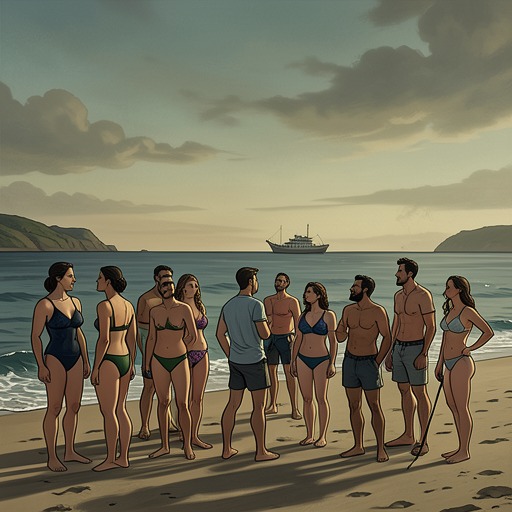
Hacine and Coralie spend two weeks at a seaside resort in Six-Fours, driving across France in their Fiat Pronto. Their days follow an unambitious routine: breakfast by the tent, visits from neighbors, time at the beach and swimming in turns so that someone can watch their belongings. Lunch is made up of tomatoes, roast chicken, fried eggplants, rice salad, and sardines; afterward, they doze in canvas chairs. Nearby, a couple listens to the Tour de France on a small radio, while the pools supply the sound of splashing and children calling. The ordinary details matter: this is a kind of social life made from proximity, routine, and time without immediate demands, rather than from formal declarations of national loyalty.
The experience surprises Hacine because he finds himself enjoying the stay. He recognizes the heat and idleness from Morocco, but the French version of a holiday strikes him as different. In supermarkets, on beaches, and even while doing routine tasks, people seem unusually intent on getting things right. Beneath the leisure sits the certainty that it will end. The holiday is a bounded interval, and the knowledge of returning home limits how freely he can inhabit it. The break offers ease, but also carries its own timetable and expectation of resumption.
The journey back and the end of leisure
Returning from Morocco with his family has usually left Hacine feeling suspended between two forms of rootlessness. After this holiday, the drive north along the A7 produces another feeling. In traffic, at gas stations, tollbooths, and rest stops, he feels accepted, as if he belongs wherever other travelers belong. The seasonal crossing of people returning from July holidays with those setting out in August makes individual journeys part of a shared national movement. For a time, millions of vacationers seem to participate in the same experience of mobility and release.
That feeling does not last without qualification. The imagined freedom of the journey home depends on being able to go back to work. Hacine’s holiday ends on Sunday, July 14; his job starts the next day. At home, the evidence of ordinary responsibilities is already waiting: the fridge is nearly empty, the dog has made a mess, and the cracked bathroom washbasin and drafty bedroom window still need attention. He and Coralie have visited Mr. Bricolage and Leroy Merlin but returned without the necessary purchases. Hacine does not know how to repair the problems and fears being cheated, so he avoids speaking to the salespeople. Leisure has not removed these domestic pressures; the holiday has merely postponed them. The return to work marks the point where an inclusive feeling of movement gives way to the particular obligations of home and employment.
A national community performed in public
The novel places this private holiday rhythm beside larger scenes in which people experience belonging together. At the Bastille Day fireworks on the beach, a thousand faces turn toward the sky as Heillange City Hall presents an elaborate display. The crowd watches the same colors and hears the same music; even Steph and Clémence, who might otherwise keep their distance from the festivities, are caught up in the spectacle. For a moment, the town’s differences seem to give way to a common act of attention. The scene makes community visible not through argument but through people gathered in one place, responding together.
The 1998 World Cup semifinal produces a still more intense version of this collective feeling. When Hacine enters the bar where Anthony is watching France play Croatia, they recognize one another. France’s opening goal brings a shared eruption: people shout, embrace, jump, and spill beer, and Anthony and Hacine join the celebration despite their history of hostility. When Lilian Thuram scores again, the crowd experiences itself as a single body, and the narrative presents national unity as a total, intoxicating fantasy in which past debts and differences appear to vanish. After France wins and reaches the final, the streets of Heillange fill with honking cars, flags, painted faces, firecrackers, and people embracing one another. The pronoun people repeat is the language of collective ownership: victory belongs to everyone present.
Yet the celebration also reveals that unity is made, not simply given. Algerian flags appear among the French tricolors, while the local National Front office closes its shutter for the moment. Those details place inclusion and exclusion in the same public scene. The crowd’s temporary fraternity does not prove that racial divisions or political antagonisms have disappeared; it shows how a shared event can briefly make a broader community feel possible.
Work, memory, and the limits of solidarity
The force of this contrast is sharpened by Heillange’s industrial past. For generations, the blast furnaces drew in people, time, and raw materials; trains carried metal away through networks that helped drain parts of the town. Anthony knows the history of the mill, whose furnaces once worked through the night and whose remaining structures are now fenced-off, deteriorating forms. The town’s collective identity was shaped not only by national holidays or sporting triumphs, but by labor and by the people who endured the industrial system. When work recedes, its physical remains and the town’s memories persist without restoring the lives and economic security built around the factory.
Luc Grandemange’s funeral shows how contested that inheritance can be. His long involvement in Metalor’s union struggles made him a figure who helped sustain bonds among workers, often by setting the mood and keeping people together. But his politics later took a chauvinistic turn: he came to blame immigrants for unemployment, a view shared by others who advocated quotas and deportations. Such beliefs were muted in the public accounts of his life, even as they circulated among people around him. The funeral thus places working-class solidarity beside a boundary drawn around who counts as belonging. Read alongside Hacine’s holiday, the contrast is central: shared leisure and national celebration can create real experiences of acceptance, but neither erases the unequal histories and exclusions that shape everyday life.